Saturday, January 5, 2013

Hooked Bookworm has moved!!!


For those of you who haven't seen the news yet, we have moved over to Typographical Era, where we are collaborating with a friend to bring you a new and improved resource for literary news, reviews, author interviews, and much more!

The content from Hooked Bookworm has been transferred over to our new site, but we will not be deleting anything from this location. You can also follow Typographical Era on Facebook, Twitter, and Pinterest.  Thanks for all your support over the last year and a half. We hope to see you all at the new site!

Wednesday, November 28, 2012

Hooked Bookworm is moving!

We are thrilled to announce that Hooked Bookworm and Opinionless have joined forces!!  Our new site, Typographical Era, will officially launch on January 1, 2013, but in the meantime, we’ll be entertaining you with a countdown of our favorite books that we read in 2012. We'll be revealing one a day so stay tuned!

And don’t forget to like our new page and follow us on Facebook, Pinterest and Twitter.  The wait is over...welcome to the Typographical Era!

Tuesday, October 30, 2012

Pure by Andrew Miller

     It's 1785 and John-Baptiste Baratte, a French engineer, has just arrived in Paris to begin a new job.  He has been hired by the Minister to the King to clean up Les Innocents, an old, crumbling cemetery that is literally overflowing with bodies.  In fact, the cemetery is so overcrowded that the graveyard walls have disintegrated and corpses are spilling into people's back yards.  The entire city smells like decay, and some people have even fallen ill due to the toxic air.  John-Baptiste arrives on the scene and is shocked by the state of the cemetery, but optimistic about his ability to improve Paris.

     Pretty soon, however, Monsieur Baratte finds that the task is much more challenging than he first expected.  He thought his presence as the city's purifier would be a breath of fresh air to the Parisians, but they are strangely suspicious of Baratte's intentions.  Les Innocents is rotting the city from the inside out, but the townspeople are curiously attached to it and hesitant to interrupt the eternal slumber of the dead.  As the project progresses, Baratte finds himself increasingly paranoid and alone, despite his efforts to purge the city of its unsavory past.  Baratte finds some solace in the friendship of Armand, a church organist, and Heloise, a Parisian prostitute, but it's not enough to make him forget that most of the city, including his workers, despise him.

     They say that Rome wasn't built in a day and Andrew Miller's novel reminds us that neither was Paris.  The city of romance, the city of lights was, in Baratte's day, a city of filth and poverty, and even though his presence means progress for the city, Baratte finds that traditions are even harder overcome than stacks of bodies.

     Pure is a very fascinating piece of historical fiction.  While John-Baptiste Baratte is a fictional character, the story of Les Innocents is solidly grounded in Paris history, and Miller's re-imagining of this volatile social and economic time is beautifully rendered, despite the unsavory subject matter.  But even so, the book sometimes felt lethargic and detached, and Baratte's personal story felt somewhat withdrawn from the novel's themes.  Perhaps this is due to his own misgivings about the task and his insecurity as a force of change and momentum.  Despite this, Pure offers a bittersweet journey to 18th century Paris, and the subject matter, while grim and sinister, couldn't be more perfect for this time of year.

Overall Rating:

Saturday, October 27, 2012

Favorite Fiction: Classics for Fall Reading


I don't know about you, but something about cool, overcast fall days makes me want to snuggle into a giant chair with a mug of hot chocolate and a nice piece of classic literature.  Maybe it's the introspective nature of the season, or the longer nights, but for me, autumn is a time for classic reading.  Here are a few of my favorite works of classic literature that are just perfect for this time of year:

Friday, October 19, 2012

Swimming Home podcast


The Man Booker Prize hype is over and Hilary Mantel has taken home her trophy, but for those of you who are interested, here is the final podcast in our BookerMarks podcast series, where my fellow collaborators analyze and discuss Deborah Levy's shortlisted novel, Swimming Home.

Tuesday, October 16, 2012

2012 Man Booker Prize Winner Announced!


Congratulations to Hilary Mantel, the recipient of this year's Man Booker Prize.  Mantel is the first British woman to win the prize twice...the only other authors who have won twice are Peter Carey and J.M. Coetzee.

If you've been following me and my collaborative bloggers on BookerMarks, then you also know that we successfully predicted Mantel as this year's winner.  Yaaay!

To read more about the big announcement, head on over to the Man Booker Prize's website!

Monday, October 15, 2012

Favorite Fiction: 2012 Man Booker Prize Contenders


Those of you who have been keeping up with me on BookerMarks already know that 6 other bloggers and I have been closely following the Man Booker Prize nominees since the longlist was announced in July.  The original longlist of 12 titles was eventually whittled down to 6 finalists, and the winner will be announced tomorrow evening.  Of the 12 longlisted titles, I was able to read and review 10, but based on my reviews and ratings, here are Hooked Bookworm's top 5 Man Booker Prize-nominated titles:

Sunday, October 14, 2012

The Lighthouse by Alison Moore


     We all know that there is a deep connection between memory and the senses.  Sights, scents, and sounds can trigger all sorts of complicated emotional responses, but for the main character in Alison Moore's Man Booker shortlisted novel, memory is hypersensitive, puzzling, and often devastating.  Futh is a quiet, middle-aged man on Holiday in Germany after a recent separation from his wife, Angela.  Their marriage has ended before Futh can accurately process exactly why, so he takes a short "vacation" to clear his head and try to figure out where things went wrong.  Along the way, he stays in a small, locally-operated hotel referred to as Hellhaus.  At the hotel, Futh finds the staff to be quite peculiar, especially Ester, who operates the hotel with her husband, Bernard.  As Futh embarks upon his painful and tedious journey of memory and self-exploration, we are alternately transported back to Hellhaus, where Futh's presence has triggered a completely separate, but somehow connected resurgence of memories and abandoned thoughts.

     As Futh scratches the surface of why his relationship with Angela failed, he is unpleasantly reminded of the other various failed relationships throughout his life, including that of his father, various neighbors, friends, relatives, and of course, his wife.  But while Futh is picking at old wounds, he is continually reminded of the deepest and most painful memory - Futh's mother abandoned him and his father during Futh's childhood, and he has never fully recovered from the tragic abandonment, probably because he never understood why his mother left in the first place.  Futh is left with certain scents and images to remind him of his long-gone mother, but most of all, he is entranced by a silver lighthouse that once contained a vial of his mother's perfume.

     While Futh originally set out on a journey to achieve peace, quiet, and possibly clarity, he finds himself increasingly and mysteriously overwhelmed by the scent of oranges, cigarette smoke, violets, and camphor.  All of these scents trigger various memories for both Futh and Ester, but neither are aware of how they intersect and why the emotional association is so strong.  Alison Moore's novel is a melancholy portrayal of loneliness, abandonment, restlessness, and regret, but Futh and Ester's stories are quietly powerful, and their memories serve as reminders of the events in our past from which our senses will never let us escape.


This review was simultaneously published on BookerMarks on 10/14/12


Overall Rating:

The Lighthouse podcast

The fifth installment of the BookerMarks podcast series is here!  To listen to my fellow BookerMarkers discussing Alison Moore's shortlisted novel, The Lighthouse, head on over to BookerMarks now!  I plan to have my own review up by the end of the day...

Thursday, October 11, 2012

Narcopolis podcast

Over at BookerMarks my collaborators and I have read/reviewed/discussed 4 out of the 6 novels on the 2012 Man Booker Prize shortlist.  This week, we gathered to discuss Jeet Thayil's Narcopolis.  To listen to our discussion of Thayil's controversial novel, head on over to BookerMarks now!

We also recently finished our podcast/discussion of Tan Twan Eng's novel, The Garden of Evening Mists. You can check that out over at BookerMarks as well.

Monday, October 8, 2012

Narcopolis by Jeet Thayil


     Jeet Thayil's Man Booker Prize-nominated novel is set in Bombay, India during the 1970s and 80s, where the city's slums are overrun with dogs, children, and detriment, and the opium dens are always full.  Narcopolis chronicles the lives of several addicts during the cultural shift from opium to cheaply-made heroin.  We meet Rashid, who owns and operates the opium shop along with the help of Dimple, a eunuch prostitute known for making the best pipe in the city.  Our narrator, Dom, wafts in and out of the story, and slowly, through flickering opium-blurred images, we see a cultural portrait emerge - one of religion, gender, sex, tradition, addiction, and the fine balance between pleasure and pain.

     Narcopolis explores the multifaceted nature of the "lowest of the low, prostitutes and criminals and drug addicts, people with no faith in god or man, no faith in anything except the truth of their own senses."  And Narcopolis is indeed a novel of the senses.  It's not always pleasant or comfortable, but Thayil's masterful, poetic prose is impossible to ignore - primarily because it will make you squirm and cringe.  But at the same time, Thayil's language is honest, sorrowful, and filled with simple, but wise observations about the relationship between freedom and addiction.

     Jeet Thayil has said in recent interviews that he was himself an opium addict for 20 years, and this perspective has allowed him to write a book that is neither condemning nor glorifying drug culture, but rather presenting its reality from the perspective of the addicts.  The characters are tortured and miserable, but they're also sympathetic and hopeful.  With Narcopolis, Thayil enlightens readers to the true nature of obsession and addiction with no political agenda or judgements.  For these characters, the addiction is consuming, but it does not snuff out their humanity.  Only Thayil's empathy and memory can inject the hopeless and destitute wanderers of Narcopolis with the compassion and understanding that their reputations so often belie.


This review was simultaneously published on BookerMarks on 10/8/12


Overall Rating:

Friday, October 5, 2012

More Halloween books for all ages


If you liked Hooked Bookworm's list of Halloween books for all ages, the check out the updated version to see more scary books for the most sinister time of year!!

Tuesday, October 2, 2012

The Garden of Evening Mists by Tan Twan Eng


     In Tan Twan Eng's Man Booker Prize shortlisted novel, Yun Ling is desperately trying to preserve her memories before a neurological illness destroys her mind and body.  Through this act of reconstruction and preservation, the horrifying experience of Yun Ling's life in a WWII Japanese internment camp is revealed, as well as her heartbreaking tale of sacrifice, survival and recovery.  As the sole survivor of the war camp, Yun Ling is unable to forgive herself for leaving her sister behind, and seeks to preserve her memory through the construction of an elaborate Japanese garden.  Soon, she begins an apprenticeship with Aritomo - a reclusive, but highly-respected Japanese artist and gardener.  Aritomo was once the gardener to the Emperor, but he eventually settled in Malaya, where he meets Yun Ling, who is still incredibly suspicious of and frightened by the Japanese, but willing to endure Aritomo's teachings for the sake of her sister's memory.

     But soon, Yun Ling's apprenticeship with Aritomo develops into a quiet, but complicated romance, and she finds out that their paths have intersected since her childhood.  Despite their intimacy, Aritomo is reluctant to share his history with his lover, and the couple compensates with a bond over nature and art.  Aritomo soon reveals that he is a master of the art of horimono tattoos - a practice that is both sacred and controversial - and he recruits Yun Ling as his next subject.  The tattoo takes months to complete, and when it is finished, Yun Ling is mesmerized by the skillful design of the tattoo.  It is certainly beautiful, but there is something mysterious and cryptic about the patterns and markings.  As Yun Ling completes her biographical account, she is enlightened to the true meaning of the horimono  - a discovery that answers questions from long ago and allows her to finally complete her long-awaited journey of healing.

     The Garden of Evening Mists is a tender story of grief, faith, sacrifice, and redemption, and the plot is well-crafted, but for me, this is not the Man Booker Prize winner.  As some other critiques of this novel have stated, the second half of the story is disappointingly predictable and the character development is somewhat underwhelming.  Even so, The Garden of Evening Mists is a fascinating depiction of war-era Malaya - a period of WWII history that is often overlooked.  Tan Twan Eng skillfully weaves the violence of war with the beauty and delicacy of Aritomo's garden to create a story that is quite a sensory experience.  The lush, vibrant landscape becomes the novel's most compelling character and reminds readers of the harmonious healing powers that nature can exude.

This review was simultaneously published on BookerMarks on 10/2/12

Overall Rating:

Saturday, September 29, 2012

BookerMarks Podcast #2: Bring Up the Bodies

Those of you following our BookerMarks discussion of the Man Booker Prize nominees will be happy to know that podcast #2 is now available.  In this installment, we discuss Hilary Mantel's shortlisted title, Bring Up the Bodies, and next week we will be talking about Tan Twan Eng's The Garden of Evening Mists.  And just so y'all know, none of this would be possible without our amazing editor/organizer, Aaron.  You can check out his literary musings over at Opinionless!  Other contributors to BookerMarks include: The Literary Hoarders, A Reader and a Rider, and 40 Gigs and a Mule

Tuesday, September 25, 2012

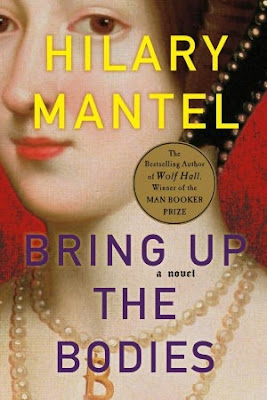
Bring Up the Bodies by Hilary Mantel


     Hilary Mantel's brilliant sequel to her 2009 novel, Wolf Hall, has once again earned her a spot on the Man Booker Prize shortlist.  Bring Up the Bodies is a continuance of Thomas Cromwell's story as it intersects with Henry VIII and his second wife, Anne Boleyn.  As the novel opens, it is the fall of 1535 - Former Queen Katherine of Aragon is on her deathbed and current Queen, Anne Boleyn, is also inching dangerously close to death.  She has made many promises in her relentless efforts to become Queen, yet the most important promise - to produce a male heir to the throne - has yet to be fulfilled.  In the meantime, rumors have begun to circulate that perhaps Anne has not been faithful to her husband, and that, perhaps their daughter, Elizabeth, was fathered by another man. 

     Pretty soon, the swirling rumors reach the ears of the King, and although Henry is outraged at the prospect of his wife's extramarital encounters, he also sees it as an opportunity to rid himself of Anne Boleyn, who has turned out to be more trouble than pleasure for Henry.  And of course, "Queens come and go," so Henry enlists the help of Master Secretary Thomas Cromwell to remove Anne Boleyn of her position so that a new (and hopefully more fertile) Queen can take her place.  Luckily for Cromwell, "the affairs of the whole realm are whispered in his ear," so the process of Anne's removal is expedited.  In fact, it takes just about a month for Cromwell to compile a case against Anne, have her tried in court, and finally beheaded.  The crimes against the infamous Queen include treason, incest, and adultery, and her trial and subsequent death prove to be extremely consequential for the Tudors.  Many others are sent to their deaths because of what they may or may not have said and done with Anne Boleyn, and Henry's Court is in disarray after living in the midst of potential conspirators and traitors.

     But even before the death of his second wife Henry's lust has found a new target - Jane Seymour.  Miss Seymour is known for her reputation of purity, innocence, and humility, and Henry would love nothing more than to marry her immediately and impregnate her with (fingers crossed!) a son.  And Henry is the King, so, with the help of the ever-faithful Cromwell, England has a new Queen less than 2 weeks after the death of Anne Boleyn.

     To British history buffs, the Tudors' story is nothing new.  Henry VIII was one of the most infamous and highly-discussed English monarchs, and his relationships with his (count em') 6 wives have been fairly well documented throughout history.  But Mantel isn't really interested in Henry or Anne or Jane or Katherine.  Of course they're all important players, but none of them compare to the true mastermind of these Tudor events.  Thomas Cromwell was always there, quietly listening in the shadows, writing everything down and memorizing every single detail of the King's personal and private affairs so that he would be prepared for anything and everything imaginable.  Thomas Cromwell made things happen before the King even realized he wanted them to happen.  He's been called cold, cruel, calculated, and evil.  But he was also probably one of the most intelligent and well-informed men in Tudor history - despite what he may have accomplished or destroyed with such knowledge.

     Either way, Bring Up the Bodies offers readers a new perspective on Henry VIII's relationship with Anne Boleyn - one that focuses on the pragmatic aspect of the surrounding events rather than the emotional or romantic facets.  As Hilary Mantel has said, Cromwell "is still in need of attention from biographers,"but even the most skilled biographer may have trouble bringing Cromwell's story to life compared to Wolf Hall and Bring Up the Bodies.

     Mantel is currently writing the third installment of this Henry VIII trilogy, which is titled The Mirror and the LightBring Up the Bodies is on the 2012  Man Booker Prize shortlist (which she won in 2009 for Wolf Hall), and The Mirror and the Light is probably already nominated for the 2013 prize.  I hope so.  And I hope she wins!

This review was simultaneously published on BookerMarks


Overall Rating:


Sunday, September 23, 2012

BookerMarks Podcast!

If any of y'all have been following the other blog I contribute to, BookerMarks, then you'll be happy to know that our first podcast discussion of Will Self's Man Book Prize shortlisted novel, Umbrella, is now available for your listening pleasure.  Check it out here!

Tuesday, September 18, 2012

Umbrella by Will Self


     Buried deep under a mess of contractions, grammatical debris, and indecipherable Cockney slang lies a story - a nouveau modernist tale that reads kind of like a hybrid of Dada, Faulkner, Eliot, and Dr. Seuss.  In Will Self's Man Booker Prize shortlisted novel, we are introduced to Zack Busner, a psychiatrist at Friern Hospital in London.  Busner and his staff primarily deal with victims of Encephalitis Lethargica - an epidemic that spread around the time of World War I and leaves its victims in a catatonic state.  Busner has been treating these patients for years with no luck, but eventually, Audrey Death begins to respond to his treatments.

     Audrey has been a patient at Friern for longer than Busner has been there, and as she slowly emerges from her catatonic state and the clouds of her mind clear away, Busner is shocked at how difficult and challenging it is to rehabilitate post-encephalitic patients in a modern world. While Audrey has absorbed more of her surroundings than Busner previously thought, most of her thoughts are stuck in the time before her affliction, and it is the hospital staff's unenviable task to modernize and rehabilitate these Sleeping Beauty patients.  After a few weeks of this, Busner begins to wonder if perhaps patients like Audrey would be "better off" if their rotting brains were left alone, but it's too late to turn back now.

     Told in the alternating voices of Audrey and Dr. Busner throughout who knows how many time periods, Umbrella should be a compelling read about war, modernity, sex, gender, experimental medicine, and the lack of accountability in the mental health system - but it's not.  Well, it might actually be about those things, but unless you're armed with a pretty highfalutin vocabulary, a working knowledge of Cockney accents and London slang, and the 3D decoder from the accompanying Umbrella cereal box, then you might just find yourself completely lost in the literary rain without a literate umbrella.

This review was simultaneously published on BookerMarks

Overall Rating:

Friday, September 14, 2012

The All of It by Jeannette Haien


     Father Declan de Loughry has lived a relatively quiet life in a quaint little Irish town.  When he's not serving his parishioners, he's usually fishing for salmon and meditating.  As Haien's novel opens, Father Declan is fishing for salmon with very little luck and distracted by thoughts of Kevin and Enda Dennehy.  The Dennehy's have been a staple in their small community for decades, and Kevin has just unexpectedly passed away.  But Father Declan is not preoccupied by grief - yes, Kevin's death is tragic, but even more worrisome is the confession that Kevin made to his priest just before his death.  Unfortunately, Kevin died before he could finish the story, so it's up to his wife, Enda, to deliver the rest of the tale and confess "the all of it."

     As Enda reveals secret after secret, Father Declan is overwhelmed by truth.  Right before his death, Kevin confessed that he and Enda were never actually married, but he died before he got a chance to explain.  Now it's up to Enda to reveal the truth - and the truth is painful, tragic, and controversial.  Father Declan is so astounded at the depth and nature of her story that he is unsure how to handle the truth.  His first instinct is to point fingers and condemn, but as Enda reveals more complications and hidden corners in her story, Father Declan's opinion of the Dennehy's shifts between amazement, horror, sympathy, and compassion.

     The All of It is a very small, but moving story built at the intersection of religion, morality, and circumstance.  Father Declan's first reaction to Enda's confession is horror and embarrassment.  He spits heavy words at Enda, saying "I'm personally mortified for the two of you.  What have you been thinking these many years...before God with your sin...and deceiving your neighbors-" (p. 12).  But the truth is more complicated than he ever imagined and by the end of the novel, Father Declan must face his own moral dilemma.

     Written in 1986 but still incredibly relevant, Jeannette Haien's debut novel is a compelling examination of a case where hard and fast religious boundaries are blurred by circumstance and tragedy - where blame is elusive and sin is uncertain.  Haien's novel may not feel overtly powerful, but its grace and candor cannot be overlooked as readers are reminded that grief, guilt, desire, and empathy are profoundly complex human emotions, and that morality can prove to be baffling and indecipherable just when we think we've mastered it.

Overall Rating: